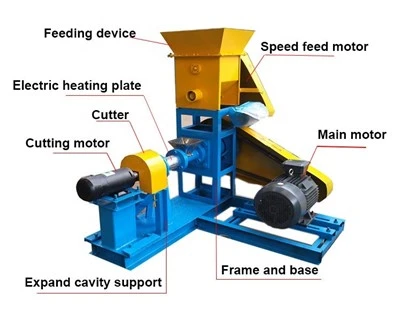
Application of Fish Feed Extruder:
Fish feed extruder is a machine that is widely used for the production of fish feed pellets. It is an efficient and cost-effective way to produce high-quality fish feed. The machine is specially designed to process a wide range of raw materials including fish meal, soybean meal, corn, wheat, rice bran, and other ingredients. The extruder heats, mixes, and compresses the raw materials into pellets that are rich in nutrients and easy to digest for the fish.
The feed extruder machine is widely used in the aquaculture industry as it offers various benefits such as increased fish growth, reduced feed wastage, and improved feed efficiency. In this article, we will discuss the working principle of the feed extruder machine, the benefits of feed pellets for animals, and the related products required to make feed pellets.

Working Principle of Fish Extruder Machine:
The fish extruder machine is designed with an advanced technology that allows it to process various raw materials to produce high-quality fish feed pellets. The extrusion technology is a continuous process that involves the following steps:
Step 1: Raw Material Preparation
The first step in the fish feed extruder process is the preparation of the raw materials. The ingredients are ground to the required particle size, and then mixed together to form a homogeneous mixture. The mixing process is essential to ensure that the ingredients are evenly distributed throughout the mixture.
Step 2: Feed Extrusion
The next step is the extrusion process, which involves passing the raw materials through the extruder machine. The extruder machine consists of a barrel, a screw, a die, and a cutter. The raw materials are fed into the extruder barrel, where they are heated and mixed by the rotating screw.
The heat and pressure generated by the screw cause the raw materials to be compressed and forced through the die. The die is a small opening through which the material is extruded. The extruded material is then cut into pellets of the desired length by the cutter.
Step 3: Drying and Cooling
After the pellets are cut, they are transferred to a dryer where excess moisture is removed from the pellets. The drying process is necessary to prevent the growth of bacteria and fungi. After the drying process, the pellets are cooled to room temperature.
Step 4: Packaging
The final step in the feed extruder machine process is packaging. The pellets are packed in bags or stored in bulk for later use.

What are the Benefits of Feed Pellets to Animals?
Feed pellets offer various benefits to animals such as improved growth, reduced wastage, and improved feed efficiency. Below are some of the key benefits of feed pellets to animals:
1. Improved Digestibility:
Feed pellets are designed to be easily digestible by animals. The pellets are compressed, which makes them easier to chew and swallow. This also improves the absorption of nutrients in the animal's digestive system.
2. Increased Feed Efficiency:
Feed pellets are designed to contain a balanced nutritional profile, which ensures that the animal's nutritional needs are met. This translates to increased feed efficiency as the animal requires less feed to meet its nutritional needs.
3. Reduced Feed Wastage:
Feed pellets are less likely to be wasted compared to other forms of animal feed. This is because the pellets are uniform in size and shape, which makes it easier for the animal to eat them. This reduces the amount of feed that is wasted and improves feed efficiency.
4. Improved Animal Health:
Feed pellets are manufactured under strict quality control measures, which ensures that the feed is free from contaminants and harmful additives. This improves the overall health of the animal, reducing the risks of diseases and infections.
What Other Related Products Are Needed To Make Feed Pellets?
To make feed pellets, there are several related products that are required. These products include:
1. Raw Materials:
The raw materials used to make feed pellets are essential for the successful production of high-quality pellets. The raw materials should be of good quality, free from contaminants, and provide a balanced nutritional profile. Some of the common raw materials used in the production of feed pellets include fish meal, soybean meal, corn, wheat, and rice bran.
2. Mixer:
A mixer is an essential piece of equipment used in the preparation of raw materials. The mixer is used to mix the different ingredients to form a homogeneous mixture that is easy to process.
3. Hammer Mill:
A hammer mill is used to grind the raw materials into the desired particle size. This is important to ensure that the feed is easily digestible by the animal.
4. Pellet Mill:
A pellet mill is the equipment used to compress the ground raw materials into pellets of the desired shape and size. The pellet mill is designed to apply pressure and heat to compress the raw materials, which results in the formation of dense and hard pellets.
Conclusion:
Fish extruder machine is an advanced and efficient way to produce high-quality fish feed pellets. The machine is easy to operate and maintain, and it can process a wide range of raw materials to produce pellets that meet the nutritional needs of fish. Feed pellets offer several benefits to animals such as improved growth, feed efficiency, and reduced wastage. To make feed pellets, various related products such as raw materials, mixer, hammer mill, and pellet mill are required. Producing high-quality feed pellets is essential for the health and growth of animals and is critical for the aquaculture industry.
Model | WSJY-40 | WSJY- 50 | WSJY-60 | WSJY-70 | WSJY-80 | WSJY-90 | WSJY-120 | WSJY—135 | WSJY-160 | WSJY-200 |
Capacity --- kg/h | 30-40 | 60-80 | 120-150 | 180-250 | 300-350 | 400-450 | 500-700 | 800-1000 | 1200-1500 | 1800-2000 |
Pelleting Diameter--- mm | 1-8 | 1—8 | 1 —10 | 1-10 | 1 —10 | 1 —10 | 1-10 | 1 –12 | 1-12 | 1-12 |
Motor Power--- kw | 5 | 7.5 | 15 | 18.5 | 22 | 37 | 55 | 75 | 90 | 132 |
Cutting Power--- w | 400 | 400 | 400 | 400 | 1100 | 1500 | 2200 | 2200 | 2200 | 3000 |
Screw Rod Diameter-- mm | 40 | 50 | 60 | 70 | 80 | 90 | 120 | 135 | 160 | 200 |
Cooking degree | >95% | >95% | >95% | >95% | >95% | >95% | >95% | >95% | >95% | >95% |
Size(m) | 1.4*1.03*1.1 | 1.45*1.08*1.25 | 1.46*1.14*1.25 | 1.6*1.4*1.35 | 1.6*1.4*1.35 | 2.1*1.45*1.35 | 2.1*1.45*1.35 | 2.55*2.05*1.65 | 2.9*2.65*1.8 | 3*2.85*1.9 |
Weight(kg) | 260 | 350 | 355 | 580 | 700 | 950 | 1700 | 1900 | 3600 | 4300 |
Populāri tagi: fish feed extruder, China fish feed extruder suppliers, factory